HidroBio sells direct — supermarket chains, a Michelin-recognized restaurant, institutional catering. But even direct sellers price against a retailer who has POS analytics, competitor feeds, and a dedicated analyst team. Before Froniva, HidroBio priced by intuition and the morning's supermarket walks. Froniva is the information layer that closed the gap.
A note on the Paraguayan market before we get to HidroBio itself. The default path for small fresh-produce growers here is the acopiador — an informal middleman who arrives at the farm gate, quotes a price against a wholesale reference only he can see, and leaves with the harvest. The alternative is driving to the Mercado de Abasto at 3 a.m. and hoping to sell before the vegetables wilt. The typical gap between what the acopiador pays and what the same crop clears at retail is 20–40%. Wholesale prices circulate as WhatsApp photos — closed groups, partial posts, always a day old. There are no vegetable cooperatives in Paraguay. Each small grower fends for themselves.
HidroBio never lived in that world. Eight years of hydroponic production, an in-market brand with its own shelf-labels, direct commercial relationships with Paraguay's largest supermarket chains, a Michelin-recognized restaurant (also ranked on Latin America's 50 Best), institutional catering. They disintermediated the acopiador the day they opened — which put them on a different, subtler problem instead.
When you sell direct to a supermarket in Paraguay, your counterparty is a category manager — the person on the retailer's side who decides what goes on the shelf, at what price, sourced from whom. Category managers have POS analytics (what sold yesterday, at what margin, pulling from which supplier), competitor feeds (what the other four chains in the country are charging), and — at the larger chains — a dedicated analyst writing daily price memos. They know exactly what your tomatoes are worth at retail. They know what substitutes are charging. They know which supplier blinked first last week.
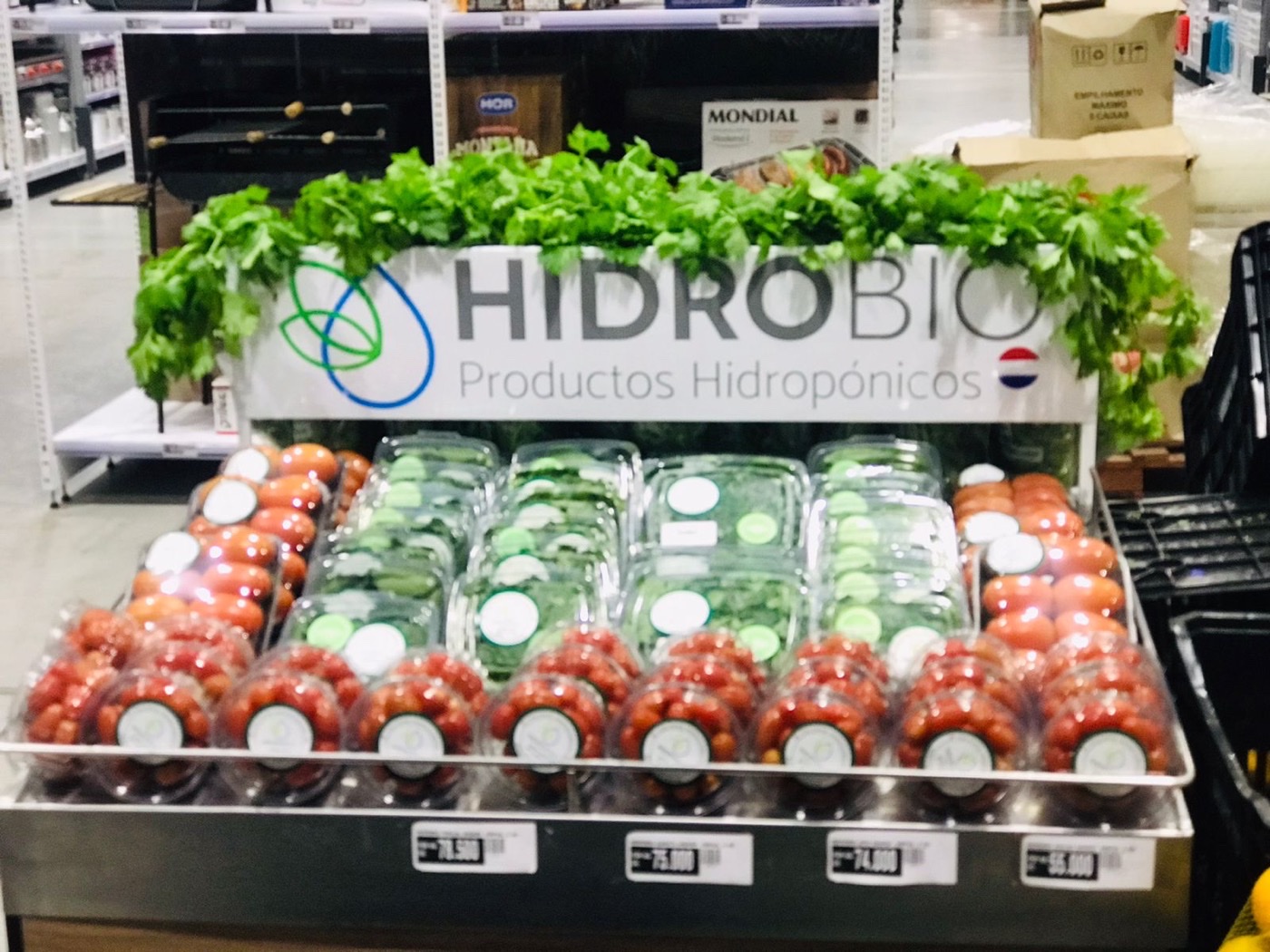
The grower on the other side of that table, pre-Froniva, had the memory of yesterday's walks. The HidroBio sales lead would physically stop at Stock and Superseis on the way to the office, photograph the shelf-tags on tomato cherry and perita, check whether her own products were facing up or hidden behind a competitor's stack, then price the day's contracts and WhatsApp quotes against that mental snapshot. Eight years of pricing this way works — HidroBio's revenue grew every year. But it leaves value on the table, every transaction, that the retailer's analytics quietly captured.
The acopiador problem exists for the small grower. The information problem exists for every grower, at every size, the moment they sell to someone with analytics.
“ Before Froniva we priced from intuition and yesterday's walks through Stock and Superseis. Now I open Froniva at 5:30 and I already know what the day looks like — the same picture the buyer already has. — Gabriela Chávez, Head of Commercial, HidroBio S.A.
A deployment like this is not an app install — it's a data contract. Here's the real timeline HidroBio moved through, from the first diagnostic call to the morning the commercial team stopped checking shelves by hand.
Two sessions with the HidroBio sales and production leads. Inventory the B2B accounts. Establish cost of production per product per month (the Piso Absoluto that pricing never drops below). Identify the 13 Asunción supermarkets where HidroBio products appear on shelves — targets for the daily scrape. Confirm the Zoho Books account structure so later sync can write item rates directly.
Each supermarket runs on a different e-commerce stack — nopCommerce (Stock), custom React + REST (Biggie, Gran Vía), WooCommerce (Casa Rica, Casa Grütter), MASCREATIVO (Areté, San Cayetano, Los Jardines), Instaleap GraphQL (Real), Pegasus with session cookies (Pryca), Laravel (Salemma). Fourteen scrapers written; one (La Bomba) discovered to carry no fresh produce; thirteen shipped to production.
SIMA — Paraguay's government wholesale market reports — publishes daily price lists as photo uploads in WhatsApp groups. A LaunchAgent watches one of those groups, pipes each image into a Claude Sonnet 4.6 vision pass, and emits a structured row per product. DAMA (the 7-day median reference) and CECOPROA (cooperative wholesale reference) added alongside. The dual-anchor pricing engine comes online: retail median × segment percentage, floored at wholesale × safety multiplier, never below cost.
December 8, 2025 · 05:02 PYT. The first Monday briefing lands in Gabriela's inbox with three recommendations and a segment-band table. The commercial team had been pricing by memory for eight years. From that Monday forward, the morning starts with a read, not a walk.
By 03:00 PYT, the customer lifecycle pipeline has finished sweeping Zoho CRM for at-risk accounts — customers who haven't ordered in 45+ days and whose median cadence is about to break. It updates Annual_Revenue, Etapa_del_ciclo_de_vida, and Entrada_de_Riesgo on the account record, then writes a short context note the sales lead will see before opening the briefing.
At 05:00 PYT, the scrapers run. Thirteen supermarkets, one product family at a time, sleep-timed to look like human browsing. The SIMA WhatsApp watcher has already OCR'd last night's upload. DAMA's 7-day wholesale median and CECOPROA's cooperative pricing are refreshed. The pricing engine computes segment targets — S1 Consumidor Final at 82% of retail median, S2 HORECA at 62%, S3 Supermercados at 52%, S4 Institucional at 47%, S5 Mayorista at 37% — each floored by a safety multiplier against the DAMA wholesale anchor.
By 05:02, the morning briefing is ready. A three-to-five card action queue — one card per product × primary segment — with RAISE / HOLD / CUT / REVIEW verbs and confidence scores. Spread-divergence alarms fire when today's retail/DAMA ratio sits ±1.5 standard deviations above the trailing 30-day mean — a signal the commercial team reads as 'margin-capture window open' or 'acopiadores incoming, defend the floor.'
Gabriela opens the briefing from her phone while the coffee is brewing. Approves the recommendations she trusts; opens the product drawer for anything with a REVIEW flag or a delta over 15% (which requires a second approver). Every approval is written to a local audit table and, when synced, propagates to Zoho Books as a new item rate — which Froniva's WhatsApp sales agent picks up automatically the next time a customer asks for a price quote.
By 06:00, the first WhatsApp order of the day arrives. The sales lead is still holding her first coffee.
Froniva never transacts — HidroBio's team sells, HidroBio's invoices go out. Every number below lives in Zoho Books and was measured against the recommendation that preceded it.
| Segment | Code | Target band | What it is |
|---|---|---|---|
| Consumidor Final | S1 | 82% | Direct retail, electronic shelf-labels in HidroBio-branded displays |
| HORECA | S2 | 62% | Restaurants + hotels — including Paraguay's only Michelin-recognized restaurant (also on Latin America's 50 Best) |
| Supermercados | S3 | 52% | Largest Paraguayan supermarket chains — Stock, Superseis, Casa Rica, Real |
| Institucional | S4 | 47% | Schools · hospitals · catering — negotiated in volume contracts |
| Mayorista | S5 | 37% | Avoided. DAMA+5% is the BATNA. HidroBio does not route product here unless the wholesale floor is the only option. |
The composition matters more than the top-line. Before Froniva, HidroBio's scarce product was split roughly equally across whoever asked first — HORECA, supermarket, sometimes wholesale on a slow week. After Froniva, the routing became explicit. S1 Consumidor Final (the shelf-labeled HidroBio product in-store) and S2 HORECA take priority; S3 Supermercados gets the volume the HORECA day doesn't absorb; S5 Mayorista is an emergency valve used two weeks in sixteen.
The +18.3% figure in the Proof section of the homepage is weighted — Tomate Cherry (high margin, short shelf life) and Tomate Perita (mid-margin, higher volume) combined, Dec 2025 through Mar 2026, measured against the pre-Froniva 6-month baseline. It is not a claim about every product, every month. Lechuga Pirati, for instance, is flat — the retail-to-wholesale spread on lettuce has never been pliable in Paraguay, and the divergence-monitor flags it for REVIEW more often than it recommends a price move.
“ The category manager always knew what our tomatoes were worth at retail. Now we know too — and we can defend the number in front of the buyer, with evidence from the day's shelves. — HidroBio sales lead, Paraguay
SIMA publishes Paraguay's wholesale prices as photos of hand-filled tables. The numbers use Paraguayan convention — Gs. 12.500 means twelve thousand five hundred, not twelve point five — and the tables lean, smudge, and sometimes include handwritten addenda. For the first four months, we ran the OCR pass on Claude Haiku 4.5 (cheap, fast, good enough, we thought).
The error rate on Paraguay-format numbers was 18%. Most errors were a decimal-vs-thousand misread — the model returned 12.5 instead of 12,500 — which would have dropped a recommendation to 0.005% of the actual price if it reached the pricing engine. The wholesale-anchor floor caught most of the bad writes before they surfaced, but not all. On April 18, 2026 we audited four months of OCR output and swapped to Claude Sonnet 4.6 for SIMA. The error rate dropped to under 2%.
We changed two things after the audit. First, every OCR'd number is now cross-checked against the trailing 7-day DAMA median before it's allowed into the pricing engine — anything more than 3× away gets flagged for manual review. Second, the model choice is now tenant-configurable. If a customer's wholesale feed is Excel rather than photos, we drop the OCR layer entirely and save the cost.
We log misses inside the product. It's one of the four principles we wrote before the first line of code — the moment a customer stops checking our numbers is the moment we have failed them.
The 1% breakeven: a 1-hectare greenhouse operator clearing 500 tons/year only needs to route 5,142 kg (1.02% of yield) through Froniva at an EUR 0.70/kg premium to cover the annual subscription. Everything above that is margin Froniva helped capture. HidroBio, four months in, has cleared breakeven on this measure multiple times over.
One customer. One deep deployment. Every layer proven end-to-end, before scaling.
The technology that works under Paraguay's conditions — high volatility, deep information asymmetry, WhatsApp-native commerce — is ready for any market. Hummelnest 2026 is where we take the next step.
— Daniel Stanca · Founder, Froniva · Asunción · Graz · April 2026